What is an animal?
The Merriam-Webster dictionary offers a simple definition of an animal: “a living thing that is not a human being or plant.” (Merriam-Webster).
However, in regulatory toxicology and research, animals and protected animals are distinct concepts. This distinction is particularly relevant to regulatory toxicology, as it offers an answer to an intriguing question: How can a test involving living vertebrate embryos be considered an alternative to animal testing? And what does this tell us about the path towards animal-free toxicology?
The legal distinction: animals and protected animals
Article 1(3)(a)(i) of Directive 2010/63/EU on the protection of animals used for scientific purposes protects live non-human vertebrates, including independently feeding larvae. In a nutshell, the Directive does not say that fish embryos are non-animals. Instead, it defines the developmental stages from which its protections apply. This means that fish embryos before the independently feeding larval stage are generally not protected under the Directive. Read Directive 2010/63/EU
The Directive ties protection to the scientific evidence that an animal can experience pain and suffering. The cutoff at independent feeding follows from that logic. It is also worth noting that, at the time, fish embryo tests were an emerging alternative to animal testing, and extending protection to embryos could have limited their use. This is my interpretation, not a documented intention of the legislators, but it illustrates how the legal definition of an “animal” and the development of alternatives interact.
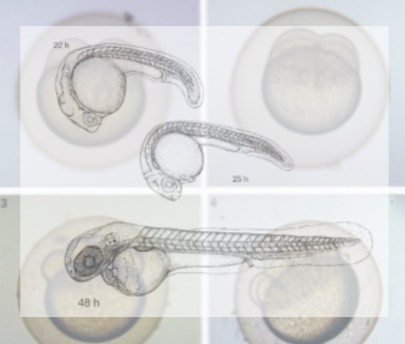
This distinction matters when considering the Fish Embryo Acute Toxicity (FET) test (OECD Test Guideline 236) as an alternative to conventional acute fish toxicity testing, such as OECD TG 203. The FET test uses newly fertilised zebrafish (Danio rerio) eggs exposed to a chemical for 96 hours. At approximately 28 °C, zebrafish generally reach the independent-feeding stage around five days post-fertilisation (120 hours). Therefore, the FET test is conducted before the independent-feeding stage and generally falls outside the Directive’s scope, subject to the conditions set out in Article 1(4).
This is supported by European Commission Implementing Decision (EU) 2020/569, which establishes reporting rules for animals used in scientific procedures, including fish. Annex III, Part B, concerning information referred to in Article 54(2) of Directive 2010/63/EU, states:
“1.1 Fish shall be reported from the stage of independent feeding when the gut is open end to end and the fish would normally take food.
1.2 The time at which fish feed independently is different for each species and in many cases dependent on the temperature at which they are kept. Temperature should be set to maintain optimal welfare, as determined by the person responsible for the welfare and care of the animals and for species-specific information in coordination with the designated veterinarian. Zebrafish larvae, which are kept at approximately +28 °C, shall be reported 5 days post fertilisation.”
The distinction is consequential: the FET test can be treated as an alternative to conventional acute fish testing under the applicable framework, but this does not mean that fish embryos are not animals.
A loophole or a step towards replacement?
At first glance, this regulatory distinction might look like a loophole. How can a test using living fish embryos be considered an alternative to animal testing? And why not start with legislation that restricts the use of all animals, regardless of their developmental stage?
To understand this, it is important to consider the technical developments at the time. The timeline below provides a clearer picture of how the FET test was developed and established as an alternative to conventional fish toxicity testing.
- 2005: The German Federal Environment Agency (UBA) submitted the draft Test Guideline (TG) Fish Embryo Toxicity (FET) Test to the OECD Test Guidelines Programme.
- 2007: The first meeting of the OECD FET Expert Consultation Group was held in Berlin.
- 2008: The OECD asked the European Centre for the Validation of Alternative Methods (ECVAM), part of the European Commission’s Joint Research Centre in Italy, to coordinate the ZFET Performance Study.
- 2010–2012: International validation of the Fish Embryo Acute Toxicity (FET) test took place, including an interlaboratory study organised by UBA in 2010–2011.
- 2010: Directive 2010/63/EU on the protection of animals used for scientific purposes was adopted.
- 2013: The OECD adopted Test Guideline 236 (TG 236) for the Fish Embryo Acute Toxicity (FET) test.
It is plausible that, when the Directive was adopted in 2010, fish embryo toxicity testing was already established in some regulatory and monitoring contexts and was being developed towards standardisation, with OECD TG 236 following in 2013. Extending the Directive’s protection to embryonic stages could have turned the test into a regulated procedure on protected animals. That would have removed much of its appeal as a non-animal alternative, at a time when no other non-animal option existed for acute aquatic toxicity assessment. This is my interpretation, not a documented intention of the legislators.
However, should the ultimate goal be to replace only those tests that legally qualify as animal testing, or should it be to develop approaches that no longer require the use of animals at any developmental stage?
From replacement to genuinely animal-free toxicology
There is a growing push for the development of truly animal-free methods. This is reflected in the European Commission’s 2026 Roadmap towards phasing out animal testing for chemical safety assessments, which identifies the development of an approach to assess acute aquatic toxicity based entirely on non-animal methods as a specific action.
This indicates that the Commission recognises the need, in the medium to long term, to replace tests involving early developmental stages of vertebrates and invertebrates in acute aquatic toxicity assessment.
What is next?
We are still on the way towards animal-free toxicology. We will get there, but achieving this goal requires more than changing the legal definition of an animal. It requires sustained scientific innovation, reliable evidence, regulatory adaptation and a commitment to replacing animal use wherever scientifically possible. The FET test is an example of how a New Approach Methodology (NAM) can be an important step towards animal-free toxicology without being the final destination. It demonstrates how regulatory toxicology must evolve alongside scientific developments and regulatory needs.
References:
1. European Parliament and Council. (2010). Directive 2010/63/EU on the protection of animals used for scientific purposes. EUR-Lex
2. European Commission. (2020). Commission Implementing Decision (EU) 2020/569. EUR-Lex
3. OECD. (2011). Validation Report (Phase 1) for the Zebrafish Embryo Toxicity Test: Part I and Part II. OECD Series on Testing and Assessment No. 157. OECD report (PDF)
4. OECD. (2012). Validation Report (Phase 2) for the Zebrafish Embryo Toxicity Test: Part I and Part II (Annexes). OECD Series on Testing and Assessment No. 179. OECD report (PDF)
5. OECD. (2013). Test No. 236: Fish Embryo Acute Toxicity (FET) Test. OECD Publishing
6. EURL ECVAM. (2014). Recommendation on the Zebrafish Embryo Acute Toxicity Test Method (ZFET) for Acute Aquatic Toxicity Testing. European Commission JRC
7. European Commission. (2026). Roadmap towards phasing out animal testing for chemical safety assessments. EUR-Lex
Merriam-Webster. (2026). Animal. Merriam-Webster.com Dictionary (Simple Definition). https://www.merriam-webster.com/simple/animal